Short answer: Amadeus, Sabre and Travelport (Galileo) do the same job: they bring the products of hundreds of airlines, hotels and car rental companies to an agency in one system. None of them is “the best”. The difference lies in the fares on the routes you sell, the commercial terms, your agents’ experience and the API for your website. This article compares the three GDSs from the point of view of an agency’s daily work and online sales, and gives a step-by-step plan for choosing.
The three GDSs at a glance
| Criterion | Amadeus / Sabre / Travelport |
|---|---|
| Headquarters | Amadeus: Madrid, Spain Sabre: Texas, USA Travelport: United Kingdom |
| System code | Amadeus: 1A Sabre: 1S Travelport: 1G (Galileo, now Travelport+), 1P (Worldspan), 1V (Apollo) |
| Booking volume (2025) | Amadeus: about 480 million air bookings Sabre: 365 million bookings Travelport: not published |
| Strongest markets | Amadeus: Europe, Middle East, Asia, Latin America Sabre: North America, Asia-Pacific Travelport: Europe, Asia, Middle East |
| Agent terminal | Amadeus: Selling Platform Connect Sabre: Sabre Red 360 Travelport: Smartpoint |
| Website API | Amadeus: Enterprise APIs (Self-Service closed in 2026) Sabre: SOAP and REST APIs Travelport: Universal API (SOAP XML) and JSON APIs |
Booking volumes come from the companies’ 2025 results (Amadeus, Sabre): Amadeus reported 471 million air bookings in 2024, and the figure grew 2.8% in 2025. Sabre’s 365 million covers all distribution bookings. Travelport is privately owned and does not disclose these figures.
An agent’s daily work: terminal and commands
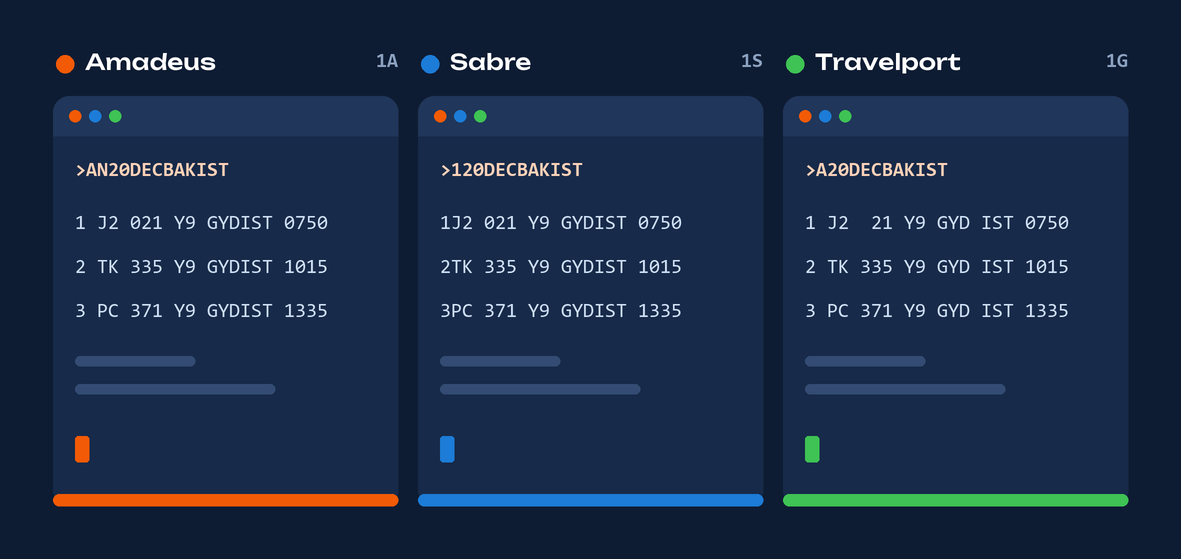
In all three systems an agent does the same things: checks availability, creates a booking (PNR), prices it, issues the ticket, and handles changes and refunds. Each has a graphical interface, but experienced agents work with short cryptic commands for speed, and those commands differ. For example, to check Baku–Istanbul flights on 20 December:
- Amadeus:
AN20DECBAKIST - Sabre:
120DECBAKIST - Travelport (Galileo):
A20DECBAKIST
So switching GDS is not just a contract question: agents need retraining, and procedures and reports must be adapted to the new system. If your team already works in one system, that is a serious factor in the choice. The steps of working in the Amadeus terminal: what is Amadeus and how it works.
Selling online: the APIs
To sell tickets on your website or mobile app without an agent, you need the GDS’s API. Each of the three has its own API, test environment and certification process:
- Amadeus: Enterprise APIs for agencies and developers. The Amadeus Self-Service APIs, designed for cheap access without a contract, shut down on 17 July 2026. Older articles still recommend them, but they no longer work. The only route now is a contract with Amadeus.
- Sabre: SOAP and newer REST APIs, with separate services for search, booking, ticketing and post-booking operations.
- Travelport: the long-standing Universal API (SOAP XML) and newer JSON APIs. Travelport now uses the name Travelport+ for Galileo.
The practical takeaway: if you want to sell through an API, agree the API terms (price, test environment, certification) in writing in the GDS contract up front. API access may also carry a separate annual fee, so ask for the amount up front. Also ask whether the developer building your system has experience with that GDS. The full list of costs: how much a flight booking system costs.
NDC: available in all three, but still a small share
Airlines increasingly sell fare bundles, baggage and seat selection through NDC. All three GDSs now show NDC content in their systems, but its share is still small: at Sabre, for example, NDC made up about 4% of air bookings in 2025.
An important point for an agency: some airlines add a surcharge to bookings made through the classic GDS channel. Under Lufthansa Group’s 2026 rules, for example, the charge for a classic (EDIFACT) ticket depends on the GDS: €18 in Amadeus, €22.50 in Sabre and €23 in Travelport, against €8 for a ticket through the GDS’s NDC channel. Air France-KLM also adds a surcharge to GDS bookings by agencies that do not use NDC. So ask: is NDC content from the airlines you sell available in this GDS, and do ticketing, changes and refunds work in the system too? The difference between GDS and NDC: what is a GDS: from Sabre to NDC.
Commercial terms: why prices are not public
None of the three GDSs publishes prices for agencies. Terms are agreed individually with the country representative or regional distributor. A contract usually includes:
- Terminal and user fees: a monthly charge based on the number of agents;
- Segment incentives: the GDS charges airlines a fee per booking (Sabre’s average booking fee was $6.07 in 2025) and may return part of that income to high-volume agencies as an incentive;
- Minimum volume: a monthly or annual segment commitment, with a penalty if you fall short;
- Term: often a multi-year contract, with conditions for early exit;
- API access: separate terms for selling on your website.
So the best approach is to get written offers from all three GDSs and compare them in one table.
How an agency should choose
- List what you sell: your top 10–20 routes and airlines.
- Check the fares: ask each GDS representative to run real searches on those routes. Prices, fare bundles, low-cost carriers and NDC content can differ.
- Look at your ticketing model: if you have no IATA accreditation and a consolidator issues your tickets, being on the same GDS as the consolidator makes things easier: you can pass the booking (PNR) straight to their office.
- Consider your team: which system do your agents know, and how long would training take?
- Compare the total cost of the written offers: terminal fees, incentives, minimum volume, contract term and API terms.
- Plan for online sales: will you need an API for a website or B2B portal, and has your developer worked with that GDS?
General selection criteria: how to choose a booking system: 10 questions.
Several GDSs together
Growing agencies often do not stop at one GDS: the same flight can be priced differently in Amadeus, Sabre, Travelport and the airline’s NDC channel. A booking system combines these sources in one search, shows the best fare and issues the ticket automatically, while agents can keep their daily work in one terminal.
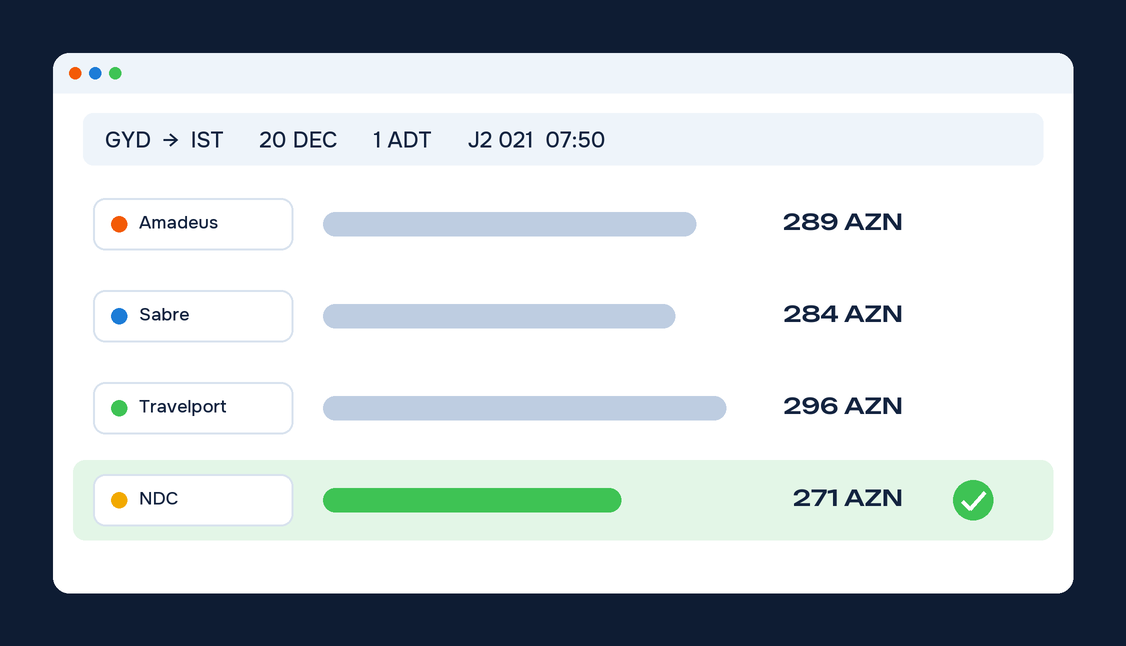
The TT Coders flight booking system works with Amadeus, Sabre, Travelport and NDC sources. On the question of a ready platform or a custom build: white label vs custom system.
Comparison checklist
| Question | Amadeus / Sabre / Travelport |
|---|---|
| Which one has the best fares on my main routes? | Check each with real searches |
| Is NDC content from the airlines I sell available? | Including ticketing, changes and refunds |
| Which GDS is my consolidator on? | The same system makes passing bookings easier |
| Which system do my agents know? | Training time and cost |
| What are the terminal fees, incentives and minimum volume? | In the written offer |
| What are the contract term and exit conditions? | In the written offer |
| What are the API terms for the website? | Price, test environment, certification |
To discuss your GDS choice, or combining several GDSs on your website, book a free consultation — we’ll show you our system in demo mode.
Frequently asked questions
Are Galileo and Travelport the same system?
Yes. The Galileo, Worldspan and Apollo systems are part of Travelport. Travelport now calls Galileo (code 1G) Travelport+, but agents still widely use the name “Galileo”.
Which GDS is the cheapest?
There is no general answer: prices are not published and are agreed individually with each agency, depending on sales volume, market and contract term. Get written offers from all three GDSs and compare the total cost.
Is it hard to switch GDS later?
It is possible, but it has a cost: the contract’s exit terms, retraining agents, and adapting booking and reporting procedures. If your website’s booking system can work with several GDSs, the switch is easier.
Amadeus Self-Service has closed — how can I connect to Amadeus now?
Since 17 July 2026, Amadeus APIs are available only under a contract with Amadeus (Enterprise). Alternatives include the APIs of Sabre, Travelport or NDC aggregators.