Today a travel agency compares fares from hundreds of airlines in seconds and issues a ticket instantly. Behind this are reservation systems with more than sixty years of history — the GDSs. This article explains what a GDS is, how it evolved from card files to today’s NDC, and what that history means for a travel agency now.
What is a GDS
A GDS (Global Distribution System) is a central reservation system that delivers the content of airlines, hotels, car rental companies and other suppliers to thousands of travel agencies and online sales channels. An agency connects to one system and sells the products of hundreds of suppliers through it.
Two more terms come up often:
- CRS (Computer Reservation System): originally the system an airline used to sell its own seats.
- GDS: a system that distributes the products of many airlines and other suppliers together. Amadeus, Sabre and Travelport are GDSs today.
Before computers: card files and telephones
In the 1950s airline seats were sold by hand: cards for every flight, boards showing seat counts and dozens of staff calling each other. As passenger numbers grew, the system struggled — confirming a booking could take hours, and mistakes led to double sales.
SABRE: the first computer reservation system
The story starts on a plane in 1953: American Airlines president C. R. Smith met IBM representative R. Blair Smith, and the idea of solving the booking problem with a computer was born. The joint project was named SABRE (Semi-Automated Business Research Environment). The system was trialled in 1960, and by 1964 all American Airlines sales ran through SABRE.
Other US airlines built their own systems: United’s Apollo, TWA’s PARS, Eastern’s System One and others. At this stage each system mainly sold its own airline’s seats.
Terminals in agencies: the systems go to market
In the mid-1970s airlines began installing their terminals in travel agencies. Agents could now see and book flights without calling the airline. The systems started showing other airlines’ flights too, and CRSs gradually turned into today’s GDSs.
A problem soon appeared: the airline owning the system displayed its own flights at the top of the screen. In the 1980s neutral display rules were introduced in the US and later in Europe.
Europe’s answer: Amadeus and Galileo
In response to American systems expanding into Europe, two European systems were founded in 1987:
- Amadeus — by Air France, Iberia, Lufthansa and SAS, headquartered in Madrid.
- Galileo — by British Airways, KLM, Swissair and other European airlines.
In 1990 Delta, Northwest and TWA merged their systems in the US to create Worldspan.
Consolidation: why three GDSs remain
Running a GDS is very expensive, so the following decades brought mergers:
- 1993: Galileo merged with the US system Apollo to form Galileo International.
- 1995: Amadeus merged with the US system System One and entered the US market.
- 2000: Sabre was fully separated from American Airlines and became an independent company.
- 2006–2007: Galileo and Apollo came together under the Travelport name, and in 2007 Travelport also acquired Worldspan.
As a result there are three major global GDSs today: Amadeus, Sabre and Travelport. Some countries also have regional systems, such as TravelSky in China and Sirena-Travel in Russia.
NDC: airlines move back to direct sales
In the 2010s airlines wanted to reduce the fees they paid to GDSs and to present their products in a richer way: baggage, seat selection, meals and different fare bundles. For this IATA developed the NDC (New Distribution Capability) standard, which sends data from the airline’s own system to the agency through a modern API.
Some airlines introduced surcharges on bookings made through a GDS and began offering their best fares only via NDC or their own websites. The GDSs responded by adding NDC content to their own systems.
GDS vs NDC: the key differences
The GDS business model is simple: the airline pays the GDS a fee for every segment sold, and the GDS passes part of that income back to high-volume agencies as incentives. With NDC, the agency connects to the airline’s own system directly or through an aggregator.
| GDS | NDC | |
|---|---|---|
| Connection | One system, hundreds of airlines | Each airline separately or through an aggregator |
| Content | Standard fares, limited ancillaries | Fare bundles, baggage, seats, meals, special offers |
| Price | Some airlines add a surcharge | Often where the best fares are |
| Ticketing and changes | Standardised over many years | Varies by airline; works on an order model |
| Technical requirement | A terminal or one API | Several APIs or an NDC aggregator |
In practice the question for an agency is not “GDS or NDC”: to give the customer the best price, you need both.
What this history means for a travel agency today
- One source is no longer enough. The same flight can have different prices in a GDS, in NDC and in a low-cost airline’s own channel.
- Automation is a condition of competition. Customers want to see the price in seconds and buy right away.
- You need a system that combines sources. Several GDSs and NDC in one search, the best fare chosen and the ticket issued automatically.
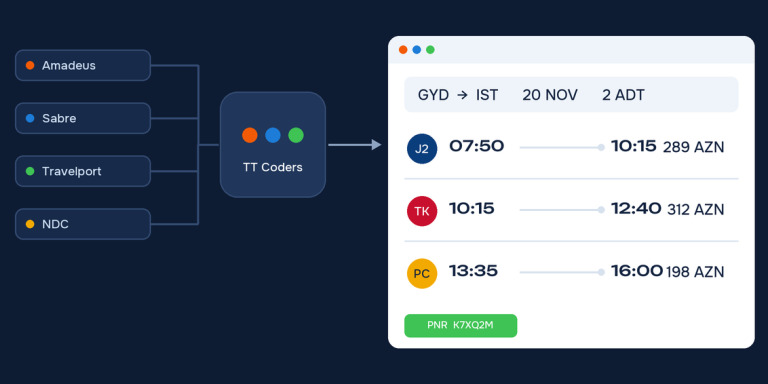
The flight booking system built by TT Coders combines Amadeus, Sabre, Travelport and NDC fares in one search on your website. The same approach works for hotels in our hotel booking system.
Frequently asked questions
What is the difference between a GDS and a CRS?
A CRS was originally an airline’s system for selling its own seats. A GDS distributes the products of many airlines, hotels and other suppliers to thousands of agencies. Today the two terms are often used interchangeably.
Do Worldspan and Galileo still exist?
Not as separate companies. Both are part of Travelport and run on Travelport’s platform, although some agents still use the old names.
Will NDC replace the GDS?
A full replacement is not expected in the near future. The more realistic scenario is that both work together: GDSs show NDC content, and agencies connect both to GDSs and to airlines’ NDC channels.
Which GDS should a travel agency choose?
It depends on the destinations you sell, the airline content you need and the commercial terms on offer. Many agencies use more than one system and combine them through APIs.