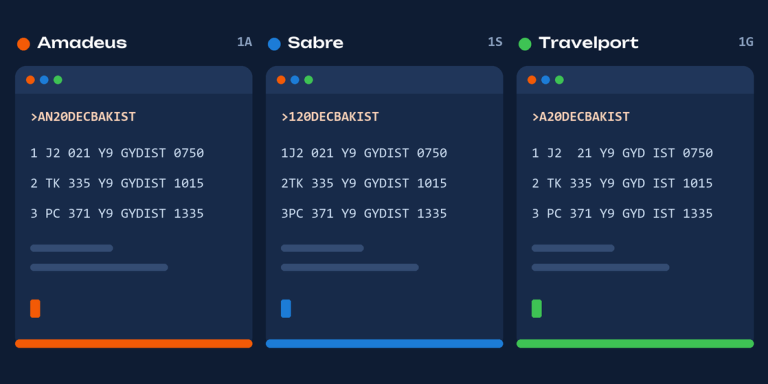
Short answer: NDC (New Distribution Capability) is an IATA standard that lets airlines send their offers — fare bundles, baggage, seat selection and special prices — directly to travel agencies through a modern API. An agency can connect to NDC in three ways: directly to the airline, through an aggregator, or inside a GDS. This article explains what NDC gives you, which route suits whom, what to prepare and what it costs.
What is NDC
NDC is a data standard approved by IATA in 2012. Before it, airline fares reached agencies only through a GDS, in an old format (EDIFACT) designed decades ago. That format mainly carries the flight, booking class and price. It struggles to show the fare bundles, ancillaries, images and personalised offers that airlines sell today.
With NDC, the agency’s system sends the request to the airline’s own system, and the airline builds the answer itself: which fare bundle, what is included and at what price. In other words, the offer and price are set by the airline, not by the GDS. On the history of GDSs and how NDC came about: what is a GDS: from Sabre to NDC.
What NDC gives an agency
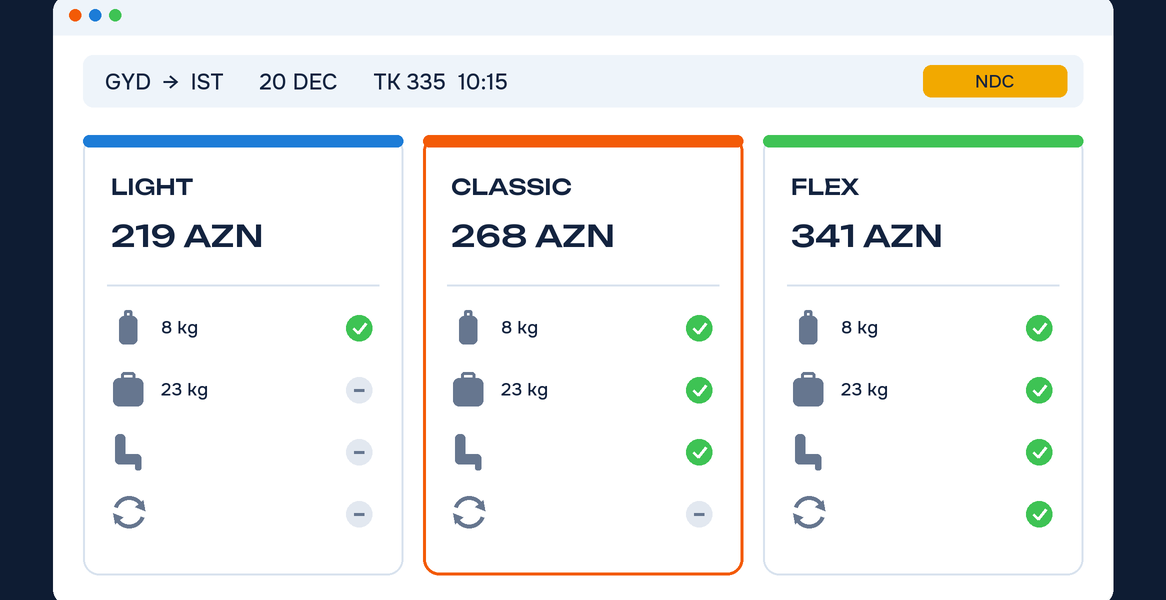
- Fare bundles: on the same flight you can clearly see bundles such as Light, Classic and Flex, and what each includes (baggage, seat selection, changes, refunds).
- Ancillaries: baggage, seats, meals and priority boarding can be sold at booking time — extra revenue for the agency.
- NDC-only fares: some airlines offer their best fares and special deals only on their own website and through NDC.
- Avoiding GDS surcharges: some airlines add a surcharge to classic GDS bookings. Under Lufthansa Group’s 2026 rules, for example, the charge is €18–23 per classic (EDIFACT) ticket depending on the GDS, €8 per ticket through the GDS’s NDC channel, and nothing through a direct NDC connection with the airline. Air France-KLM also adds a surcharge to GDS bookings by agencies that do not use NDC.
Large airlines such as Lufthansa Group, Air France-KLM, British Airways, Emirates, Qatar Airways and Turkish Airlines run NDC programmes. But what each airline offers through NDC, and which operations it supports, differs.
Offers and orders: the logic of NDC
NDC is built on two key concepts:
- Offer: the airline’s answer to a specific request: flight, fare bundle, conditions and price. An offer is valid for a limited time; the price may change after that.
- Order: the record created when the customer accepts an offer. Flights, ancillaries and payment are kept in one place.
In the classic model these are separate documents: the booking (PNR), the e-ticket and the EMD for ancillaries. IATA’s goal is to replace them with a single order (ONE Order). But the transition is gradual: today, most NDC bookings still create a PNR and an e-ticket behind the scenes. The practical meaning for an agency: check separately, for each airline, how changes and refunds work through NDC.
How an agency connects to NDC: three routes
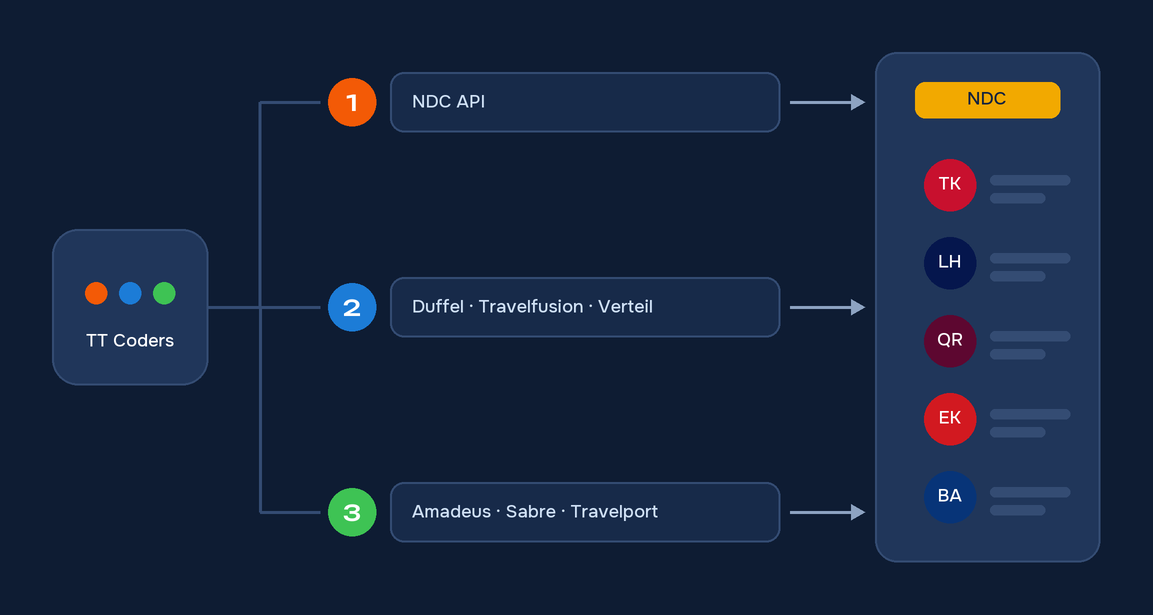
| Route | How it works and who it suits |
|---|---|
| 1. Direct to the airline | The system connects to the airline’s NDC API. It requires an agreement with the airline, usually an IATA number, testing and certification. Each airline is a separate integration. Suits agencies and tour operators that sell a lot of one or two main airlines. |
| 2. Through an aggregator | One API brings NDC content from dozens of airlines (for example Duffel, Travelfusion, Verteil, AirGateway). Some aggregators let you sell without IATA accreditation. Suits agencies that want to start quickly and sell several airlines. |
| 3. Inside a GDS | Amadeus, Sabre and Travelport show NDC content in their systems. Agents work in a familiar terminal, and a new contract may not be needed. The simplest route for agencies already on a GDS, but not every airline and not every operation is available yet. |
In practice many agencies combine the routes: classic GDS fares, the GDS’s NDC content, and a direct or aggregator connection to their main airlines. A comparison of the GDSs’ NDC capabilities: Amadeus, Sabre or Travelport.
What to prepare before connecting
- Sales list: which airlines do you sell most, and do they have an NDC programme?
- Ticketing authority: airlines usually require an IATA number for a direct connection. Without IATA accreditation, selling through an aggregator or consolidator is the more realistic route.
- Payment model: payment can go through BSP, by the customer’s card directly to the airline, or from a balance held with the aggregator. Confirm in advance which one works.
- Technical integration: connecting search, offer, order, payment and post-booking operations through the NDC API to your booking system, then testing and certification.
- Post-booking processes: changes, refunds and schedule changes, and how they will appear in reports and accounting.
What NDC costs
- Aggregator: prices are often on request. Duffel, one of the few that publish prices, charges $3 per order and $2 per ancillary (October 2026). Some aggregators also require an initial deposit to get started.
- NDC inside a GDS: terms depend on the GDS contract. In some markets the GDS charges agencies a separate fee for NDC bookings. So check in the GDS contract whether NDC bookings carry an extra fee.
- Direct connection: the airline usually does not charge the agency, but each airline’s integration, testing and certification is separate work and cost.
- Integration: adding an NDC source to the booking system is part of the project. The full cost picture: how much a flight booking system costs.
What to be ready for
- Every airline is different: several versions of the NDC standard are in use (for example 17.2, 18.1, 21.3), and airlines implement it differently.
- Post-booking operations are not complete: at some airlines, changes or refunds still do not work through NDC and have to be done via the airline’s call centre or website.
- The share is still small: at Sabre, for example, NDC made up about 4% of air bookings in 2025. So NDC does not replace the GDS yet; it complements it.
- Reporting and accounting: NDC orders can look different from classic tickets. Plan in advance how they will be recorded correctly in BSP reports and accounting.
NDC and GDS in one search
For the customer the source makes no difference: they want the best price and clear conditions. So the booking system should show NDC and GDS fares in one search, compare the bundles for the same flight, and handle post-booking operations correctly for each source. The TT Coders flight booking system combines Amadeus, Sabre, Travelport and NDC sources in one search.
To work out together which NDC route makes sense for you, book a free consultation. General selection criteria: how to choose a booking system: 10 questions.
Frequently asked questions
What does NDC stand for?
NDC (New Distribution Capability) is an IATA standard for airlines to send their offers to agencies through a modern API. With NDC, an airline can show fare bundles, ancillaries and personalised prices to an agency directly.
Can I sell NDC content without IATA accreditation?
A direct connection to an airline usually requires an IATA number. But some NDC aggregators let agencies without IATA accreditation sell too. In that case the ticket is issued in the name of the aggregator or a consolidator.
Are NDC fares always cheaper?
Not always, but often. Some airlines offer their best fares only through NDC and add surcharges to GDS bookings. The best results come from comparing NDC and GDS fares in one search.
Will NDC replace the GDS?
Not in the near future. GDSs are adding NDC content to their systems, and agencies use both GDS and NDC channels. The more realistic scenario is the two working together.