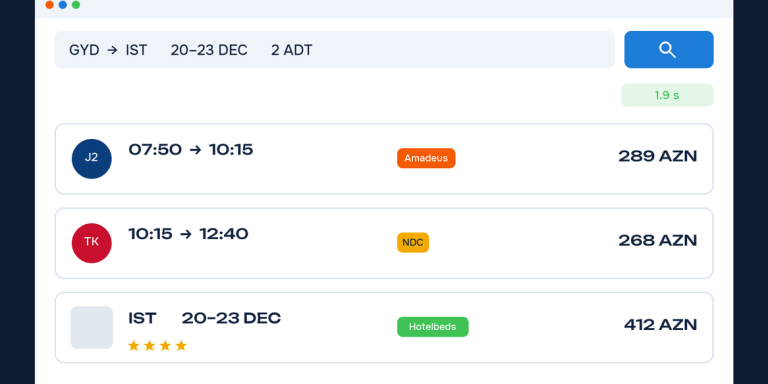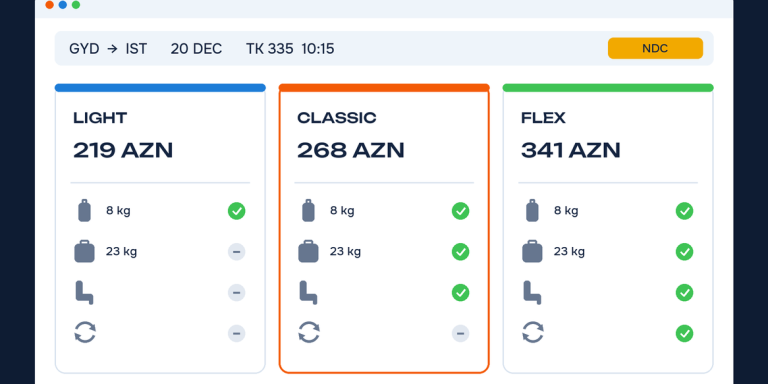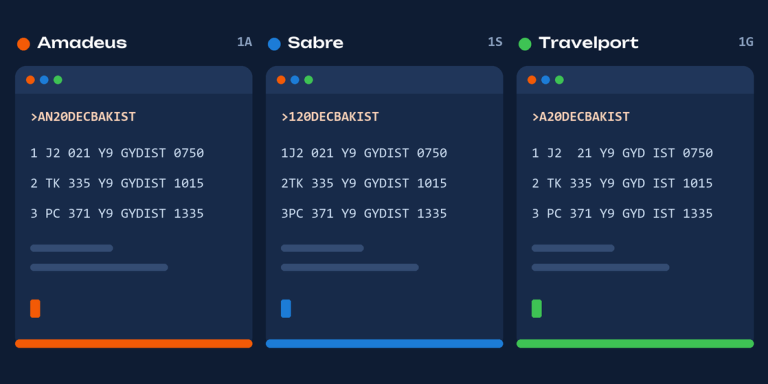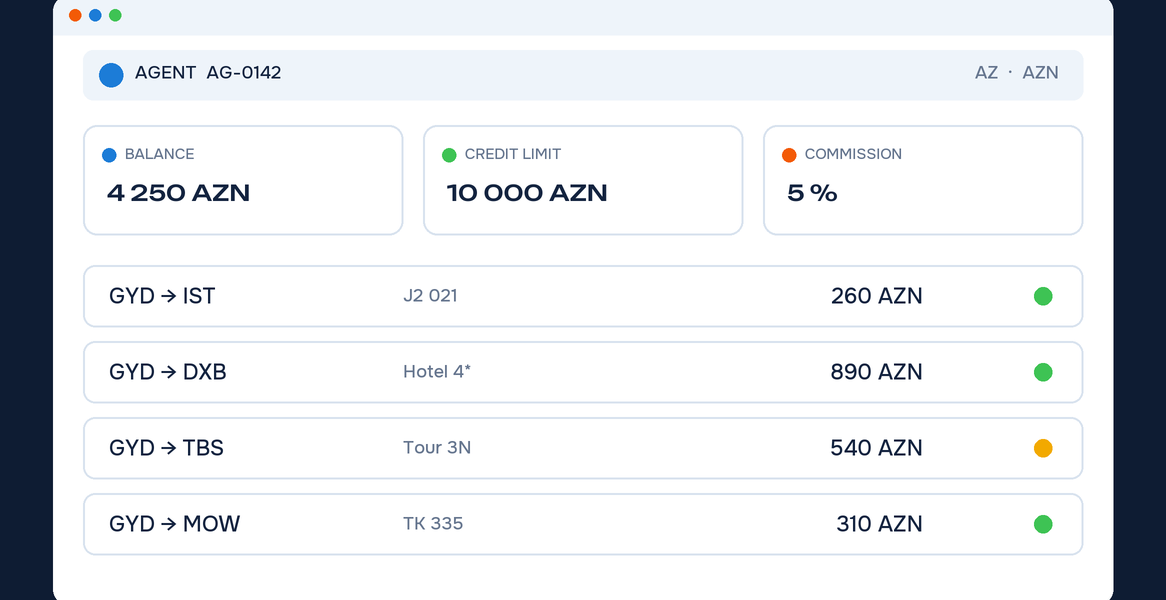
Short answer: a B2B portal is a closed online platform where a tour operator, consolidator or large agency sells to its sub-agents, that is, to other travel agencies. Each agent logs in with their own account, searches for flights, hotels and tours, books, and pays from their own balance or credit limit. The operator manages prices, commissions, credit limits and debts from one panel. This article explains how a sub-agent system is set up, the pricing models in figures, credit risk, and what to look at when choosing a portal.
What a B2B portal is and how it differs from a B2C website
On a B2C website the end customer buys and pays the final price by card. On a B2B portal the buyer is another agency: it buys from you at a net price or with a commission, and sells to its own customer at its own price.
| Criterion | B2C website / B2B portal |
|---|---|
| Who buys | B2C: the end customer, the traveller B2B: sub-agents, corporate clients |
| Access | B2C: public website B2B: accounts for approved agents only |
| Price | B2C: final price B2B: net price or commission |
| Payment | B2C: bank card B2B: deposit balance, credit limit, invoice |
| Documents | B2C: ticket and voucher to the customer B2B: ticket, voucher, invoice and settlement statement to the agent |
Both channels can run on the same booking system: search, suppliers and booking are the same; the difference is in pricing rules, payment and access. How the system itself works: what is a booking engine.
Who needs a B2B portal
- Tour operators: those who sell their own tour packages, allotments and charter seats through agents.
- Consolidators: those who sell flight tickets to agencies without IATA accreditation.
- Destination management companies (DMC): those who sell hotels, transfers and excursions to foreign agencies.
- Large agency networks: those who want one sales system for branches and partner agents.
Pricing models: net or commission
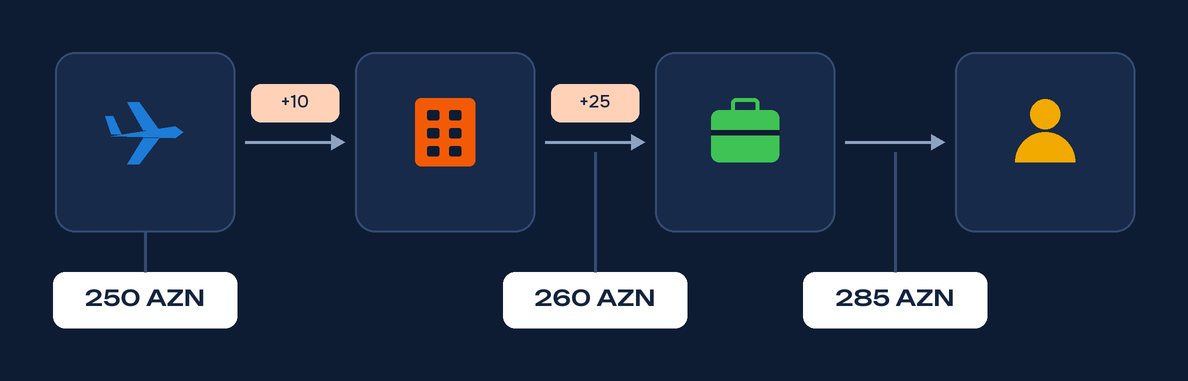
In a sub-agent system, money moves in one of two models. On the same ticket:
- Net model: the ticket costs 250 AZN from the supplier. You add 10 AZN for this agent group, so the agent sees and pays 260 AZN on the portal. The agent sells it to the customer for 285 AZN with their own markup; 25 AZN is their profit. Your profit is 10 AZN.
- Commission model: the agent sees the final price, 285 AZN, on the portal and sells to the customer at that price. You return a commission of, say, 5% of the sale, about 14 AZN, or deduct it from the payment.
The net model gives the agent freedom to set their own price. The commission model suits tour operators who want one price across the market. A good portal supports both and lets you set rules separately by agent, agent group, destination, supplier and product.
Credit limits and debt risk
The main risk in B2B sales is debt: the agent books but pays late. A portal prevents this with:
- Deposit: the agent tops up their balance in advance, and booking is only possible when the balance covers it. The safest start for new agents.
- Credit limit: a trusted agent can book on credit up to a set amount, for example 10,000 AZN.
- Payment terms: a due date for each booking or each invoice.
- Automatic blocking: when the limit is reached or a payment is late, new bookings are stopped and both the agent and you are notified.
- Debt report: debts, payments and overdue amounts for every agent in one list.
Onboarding an agent and their account
- Registration request: the agent submits a request on the portal and uploads company details and documents.
- Approval: you sign the contract, add the agent to a group (pricing and commission rule), and set a deposit or credit limit.
- Users: an agency can have several users — owner, manager, cashier — each with their own rights.
- Work: the agent searches, books, and downloads tickets and vouchers. Vouchers carrying the agent’s own logo and contact details are a big plus for agents.
- Settlement: at month end, a settlement statement of sales, payments and commissions is prepared automatically.
For large agents a portal is sometimes not enough: they want to sell your products on their own website. For that, the portal needs API access.
Reports and accounting
- sales by agent, destination and product;
- each agent’s balance, debt and commission;
- supplier settlements and margin calculation;
- export to accounting software.
When the portal and accounting work separately, it means hours of manual reconciliation every month. Our solution: accounting and back office.
What to look at when choosing a B2B portal
- Does it support both net and commission models, with rules by agent group, destination and supplier?
- Are there deposits, credit limits, payment terms and automatic blocking?
- Can an agency have several users and roles?
- Can vouchers and tickets carry the agent’s brand?
- Are settlement statements and accounting export automatic?
- Is there API access for large agents?
- Can a B2C website run on the same system?
General selection criteria: how to choose a booking system: 10 questions. To write down your requirements: technical specification template.
What a B2B portal costs
On ready platforms, B2B features are often only in the most expensive plan. For example, in scripts sold with source code the B2B portal comes in the $9,999 plan, and on some subscription platforms sub-agent channels are only in the custom-quoted plan. Development shops estimate a custom B2B platform at $25,000–70,000. At TT Coders a project costs 500–3,000 AZN, and server and support 50–200 AZN a month; a B2B portal with sub-agents falls in the upper part of that range. More: how much a flight booking system costs and white label vs custom system.
To see how the portal would work for your agent network, book a free consultation — we’ll show you our system in demo mode. Our solution: B2B agent portal.
Frequently asked questions
What is a B2B portal?
A B2B portal is a closed online platform where a tour operator or consolidator sells to its sub-agents. The agent books with their own account and pays from their balance or credit limit, while the operator manages prices, commissions and debts.
Does a sub-agent need IATA accreditation?
No. On a B2B portal the ticket is issued in the name of the operator or consolidator. Many sub-agents use a B2B portal precisely because they have no IATA accreditation.
Can a B2B portal and a B2C website run on the same system?
Yes. Search, suppliers and booking stay in one system; only pricing rules, payment and access differ. It is cheaper and easier to manage than two separate systems.
Which is better, the net or the commission model?
It differs for each company. The net model lets agents set their own price, while the commission model keeps one price across the market. Many operators use both: for example, net for flights and commission for tour packages.