Every hotel room a travel agency sells comes from somewhere: a contract with the hotel itself, a large hotel chain’s system, or a supplier that gathers thousands of hotels in one place. This article explains how hotel chains work, who the biggest chains are, and which sources and terms an agency can use to buy hotels.
What is a hotel chain
A hotel chain is a group of hotels operating under one company’s management or brand with shared service standards. A guest expects roughly the same level at any of the chain’s hotels in any country: the room, breakfast, check-in and the loyalty programme.
Chains run hotels under different models:
- Ownership: the hotel belongs to the chain and is run by it.
- Management contract: an investor owns the building, and the chain runs the hotel under its brand.
- Franchising: the owner uses the brand and its standards and pays the chain a fee, while keeping the management.
- Voluntary associations: independent hotels join together for a shared brand, marketing and booking system (for example, Best Western).
The world’s largest hotel chains
By number of rooms, the largest chains are mostly American, European and Chinese companies, each with dozens of brands:
- Marriott International — Marriott, Sheraton, Westin, Ritz-Carlton, JW Marriott and more. Considered the largest chain by number of rooms.
- Hilton — Hilton, DoubleTree, Hampton, Conrad, Waldorf Astoria.
- IHG Hotels & Resorts — InterContinental, Crowne Plaza, Holiday Inn.
- Accor — Sofitel, Fairmont, Novotel, Mercure, ibis.
- Wyndham, Hyatt, Choice Hotels and Chinese chains such as Jin Jiang and Huazhu.
Baku has many international chain hotels too: Hilton, JW Marriott, Four Seasons, Fairmont, Hyatt Regency, Holiday Inn and others. Still, independent hotels make up a large share of sales in Azerbaijan and the region.
Where travel agencies get hotels from
An agency has five main sources of hotel content:
1. A direct contract with the hotel
The agency agrees special rates or an allotment (a set number of rooms) with the hotel. The price is often the best, but every hotel needs separate negotiation, rate sheets and manual availability checks. It makes sense for the destinations the agency sells most.
2. Bedbanks and wholesalers
A bedbank is a wholesaler that contracts thousands of hotels and sells them to agencies at net rates. Hotelbeds, WebBeds, GoGlobal, Hotelston and RateHawk are examples. One API gives access to hundreds of thousands of hotels with real-time confirmation.
3. Hotel content in the GDS
Amadeus, Sabre and Travelport also show rooms from large hotel chains. This is convenient for corporate travel and for agencies selling hotels together with flights.
4. Partner programmes of online platforms
Platforms such as Booking.com and Expedia have programmes for agencies and partners. The choice is huge, but prices and commission follow the platform’s rules.
5. Direct connections through channel managers
Hotels manage rates and availability through channel managers. Through these systems an agency can receive rates and availability automatically from its contracted hotels.
| Source | Advantage | Drawback |
|---|---|---|
| Direct contract | Best price, special terms | Separate work with each hotel, manual management |
| Bedbank | Very wide choice, real-time confirmation | The same hotel’s price differs by supplier |
| GDS | One system with flights | Mostly chain hotels |
| Online platforms | Largest choice | Terms depend on the platform |
Net rates, commission and cancellation terms
- Net rate: the supplier gives the agency a room at a set price, and the agency adds its markup.
- Commission: the agency sells the room at the hotel’s selling price and receives an agreed percentage.
- Cancellation terms: free cancellation periods, non-refundable rates and penalties differ by supplier. A wrongly shown cancellation term costs the agency money directly, so it must be clear to the customer at booking.
Key hotel booking terms
Terms you will often meet in supplier responses and contracts:
- Board types: RO — room only; BB — bed and breakfast; HB — half board; FB — full board; AI — all inclusive; UAI — ultra all inclusive.
- Run of house (ROH): the room type is assigned by the hotel on arrival; usually cheaper.
- Stop sale: the hotel has stopped selling certain dates; no bookings are accepted for them.
- Release: the date when unsold rooms in an allotment go back to the hotel.
- Minimum stay: on some dates bookings are only accepted for a set number of nights.
- Rate parity: the requirement that a hotel keeps the same selling price across channels.
- Tourist tax and city fees: in some countries they are not included in the price and are paid at the hotel. Telling the customer in advance prevents complaints.
The challenge of working with several suppliers
When an agency connects to two or three bedbanks, the same hotel appears in the list several times with different names and prices. The answer is hotel mapping: the system recognises the same hotel across all suppliers, shows it once and picks the best offer. On top of that you need automatic vouchers, currency conversion and tracking of settlements with each supplier.
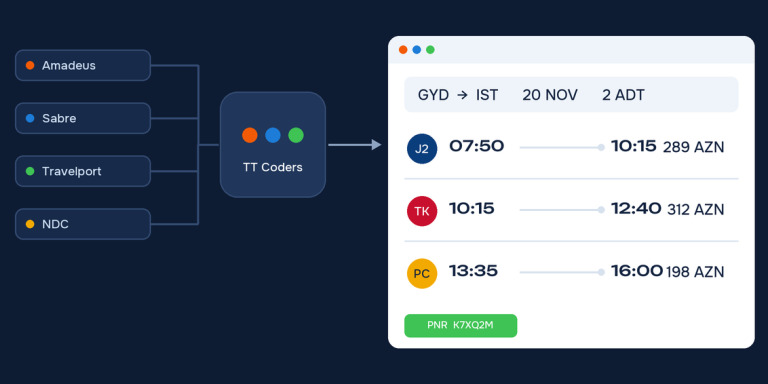
At TT Coders we have built integrations with Hotelbeds, GoGlobal, Hotelston, Booking.com and other suppliers. Our hotel booking system combines these sources in one search, removes duplicates and sends vouchers automatically. To sell hotels with flights as packages there is the tours and packages module, and for sub-agents the B2B agent portal.
Frequently asked questions
What is a bedbank?
A bedbank is a wholesaler that contracts thousands of hotels and sells rooms to agencies and online sellers at net rates. With one contract and one API an agency gets access to a large number of hotels.
Which source is the most profitable?
There is no universal answer. For best-selling destinations a direct contract usually gives the best price, while bedbanks are needed for a wide choice. The best result comes from combining several sources and automatically choosing the best offer for each hotel.
How can an agency work directly with a hotel chain?
Large chains have sales teams and programmes for agencies. Agencies with corporate or group business can agree special rates with the chain’s regional sales office; for smaller volumes, GDSs and bedbanks are more practical.