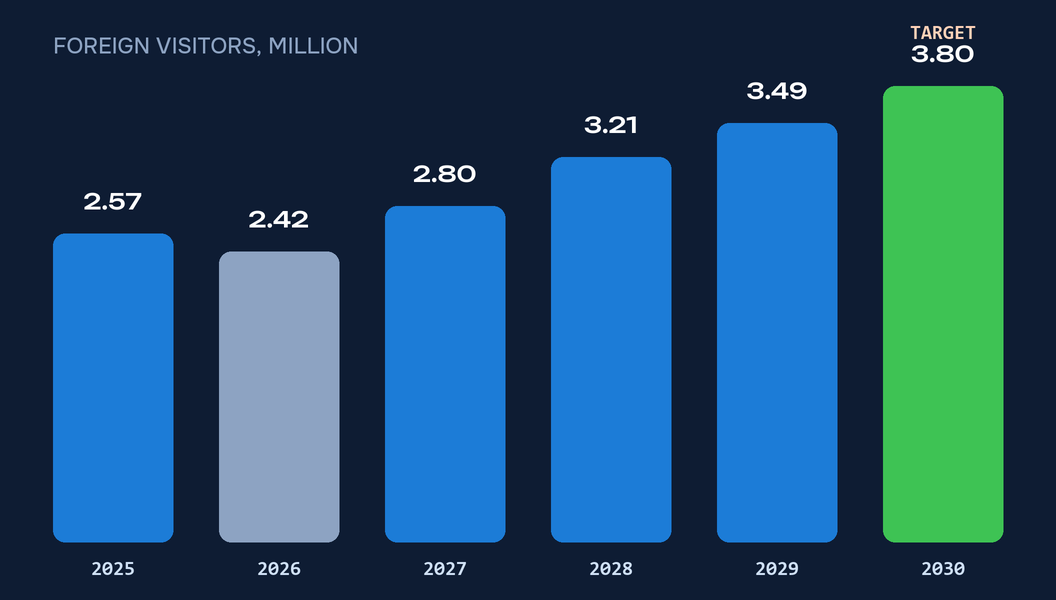
Short answer: the “State Programme for the development of tourism in the Republic of Azerbaijan for 2026–2030” was approved by Presidential Order No. 1182 of 20 August 2026. The programme aims to raise the number of foreign visitors to 3.8 million and foreign tourist spending to 6.3 billion AZN by 2030. For the tourism business, the most important part is six subsidy mechanisms: charter flights, additional scheduled flights, events, accommodation infrastructure, tour operators who bring tourists to Azerbaijan, and micro and small tourism businesses. The subsidy terms are still being drafted; the mechanisms are planned to launch in 2026–2027.
Last checked: 31 October 2026. We will update this article when the subsidy terms are published. Official source: text of the State Programme (in Azerbaijani).
The programme’s main targets
| Indicator | 2025 (baseline) | 2026 (expected) | 2030 (target) |
|---|---|---|---|
| Foreign nationals and stateless persons visiting Azerbaijan | 2.57 million | 2.42 million | 3.80 million |
| Tourism receipts (foreign tourist spending) | 3.3 billion AZN | 2.9 billion AZN (forecast) | 6.3 billion AZN (forecast) |
| Hotel nights | 4.57 million | 4.47 million | 6.32 million |
| Domestic tourism trips (Azerbaijani citizens) | 5.86 million | 6.01 million | 7.37 million |
| Value added in tourism-characteristic industries | 6.96 billion AZN | 7.58 billion AZN | 12.17 billion AZN |
One point stands out: the programme expects inbound tourism to fall in 2026 (from 2.57 to 2.42 million) and plans growth from 2027. The subsidy and incentive mechanisms therefore arrive during a difficult period for the market.
Nine priority areas
- Tourism governance: aligning tourism, visa and transport policy.
- Quality of regulation: legislation, the Tourism Register, quality requirements.
- Tourism development in the regions and communities.
- Brand, marketing and communication.
- Tourism products and experiences.
- Digitalisation, technology and innovation.
- Tourism statistics, data-driven analysis and research.
- Investment in tourism and public–private partnership.
- Human resources development.
Below we pick out the measures that matter directly to tour operators, travel agents, hotels and travel startups.
Subsidies for the tourism business
The programme’s section on a “flexible and comprehensive incentive framework in tourism” provides for six subsidy mechanisms:
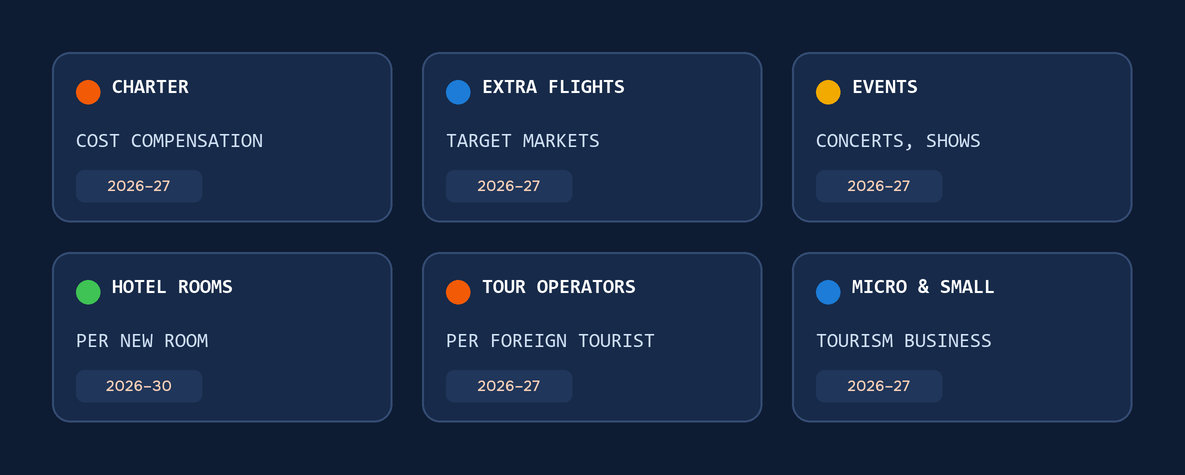
| Subsidy mechanism | Who it is for | Timeline |
|---|---|---|
| Compensation of costs for organising charter (non-scheduled) flights | Charter organisers | 2026–2027 |
| Additional scheduled flights to target tourism markets | Flight organisers | 2026–2027 |
| Partial compensation of costs for events of tourism significance (concerts, entertainment) | Event organisers | 2026–2027 |
| Subsidy for accommodation infrastructure (per newly built hotel room put into use) | Investors in hotels and other accommodation | 2026–2030 |
| Subsidy per foreign tourist brought to the country | Tour operators | 2026–2027 |
| Subsidies for micro and small businesses in tourism | Micro and small tourism businesses | 2026–2027 |
Under the action plan, each mechanism goes through three stages: setting the subsidy terms and drafting the legal acts, approving those acts, and then launching the mechanism. The State Tourism Agency is the main implementing body.
The programme also provides for two investment incentives:
- Interest subsidy: on manat loans from banks for investment projects in tourism and recreation zones: hotels, sanatoriums and resorts, arenas for winter sports, and the organisation of congresses and trade fairs.
- Investment promotion document: adding tourism projects to the list of strategic investment projects. The incentive is planned to remain in force until the end of 2030, with the document issued by the Ministry of Economy on the basis of the State Tourism Agency’s opinion.
When the subsidy terms will be known
Under the Presidential Order, the Cabinet of Ministers must submit its proposals on the subsidy terms to the President within three months, that is, by about the end of November 2026. Cabinet of Ministers Order No. 639s of 28 August 2026 instructed the ministries and the Agency to submit their proposals on the incentive framework, interest subsidies and air transport by 20 October 2026 (nk.gov.az).
So, as of 31 October 2026, the subsidy terms have not been published: who can apply, how much the subsidies will be and which documents will be required are not yet known. We will update this section when the terms are announced.
Changes to legislation and the Tourism Register
- Improving the Law “On Tourism” (2026–2028): setting minimum requirements and control mechanisms for tour operators, travel agents, hotels and other accommodation. The State Tourism Agency must submit its proposals for amending the law to the Cabinet of Ministers by 20 December 2026.
- Consumer disputes: improving the dispute resolution mechanism in tourism.
- Tourism Register (2027–2028): improving the rules for keeping the register of tourism industry entities. Current rules: the Tourism Register.
- Single classification (2027–2029): creating a single classification system for tourism industry entities.
Today the core obligations of a travel company are civil liability insurance, the Register and a written contract: how to open a travel company in Azerbaijan.
Visas and aviation
- Visa-free travel: raising the number of target tourism markets whose citizens travel visa-free with an ordinary passport, first to 28 and then to 34 countries (2026–2030).
- E-visa: improving the issue of multiple-entry e-visas through the ASAN Visa system (2026–2027), adding countries eligible for e-visas and visas on arrival, and creating a new “digital traveller” visa subtype.
- Flights: expanding the geography and frequency of direct air links, attracting new international flights and low-cost carriers to regional airports, and making air fares more affordable.
- Nakhchivan: setting the terms for tour operators to run Baku–Nakhchivan–Baku charter flights, and developing a sales model that lets tour operators book tickets on this route on condition that they sell them as part of a tour package (2026–2028).
Digitalisation: what changes for travel companies
- Tourism Information System (2026–2030): a single platform bringing together the state’s tourism registers, databases and e-services. More use of digital tools between government and business is expected.
- Azerbaijan.travel (2026–2030): rebuilding the platform on a new technology base, with multilingual services, interactive maps, and integrated booking and visitor information.
- Rail tickets in GDS (2026–2030): talks on integrating rail ticket sales into global distribution systems (GDS). This could let agencies sell train tickets from their own systems, just like air tickets. What a GDS is: what is a GDS.
- Innovation competitions (2027–2029): innovation competitions supporting the tourism industry, financial support mechanisms, and three pilot projects implemented over the period.
What a travel company should prepare for now
- Check your compliance. Civil liability insurance, an up-to-date Tourism Register entry and a compliant contract are the basic requirements. Even though the subsidy terms are not yet known, a company that wants state support should have these obligations in order. On insurance: liability insurance.
- Keep records of the tourists you bring in. The programme provides a subsidy to tour operators per foreign tourist. The terms are unknown, but if the subsidy is calculated per tourist brought in, that number will have to be backed by documents. If each tourist’s country, travel dates, tour package and voucher are kept in a system, such a report takes minutes.
- Build products for target markets. Wider visa-free travel and e-visas may create demand from new markets. A multilingual website, prices in foreign currency and online payment are the core tools for inbound sales. To sell flight, hotel and transfer as one package: dynamic packaging.
- Follow the announcements. Subsidy terms, legislative changes and Register rules will be published on the State Tourism Agency website.
How a system helps
The programme’s requirements and incentives meet at one point: data. When it is in one system how many tourists came from which country, on which flight, which hotel they stayed in and which package they bought, it becomes easier to report for subsidies, to meet Register obligations and to exchange data with the future Tourism Information System. A booking and back-office system keeps bookings, vouchers, payments and reports in one place.
To work out what your system needs, fill in the technical specification template or book a free consultation.
Frequently asked questions
When was the 2026–2030 State Programme for tourism approved?
The programme was approved by Presidential Order No. 1182 of 20 August 2026. The Cabinet of Ministers adopted Order No. 639s of 28 August 2026 on its implementation.
Which subsidy will tour operators be able to receive?
The programme provides for a subsidy to tour operators per foreign tourist brought to Azerbaijan, as well as compensation for the costs of charter flights. The subsidy terms are still being drafted and are planned to apply from 2026–2027.
Can micro and small tourism businesses get a subsidy?
The programme provides for subsidy support to micro and small businesses in tourism. The terms, amounts and application procedure have not yet been published.
How many tourists does the programme target by 2030?
It aims to raise the number of foreign nationals and stateless persons visiting Azerbaijan from 2.57 million in 2025 to 3.8 million in 2030.