Short answer: a bedbank is a supplier that sells hotel rooms wholesale, at net rates, to travel companies. Bedbanks such as Hotelbeds, WebBeds, GoGlobal, RateHawk and TBO give you hundreds of thousands of hotels through one contract. Connecting to them from your website via API takes a contract, integration in a test environment and certification. This article explains what a bedbank is, how its API works, the steps to connect, typical problems and costs.
What is a bedbank
A bedbank (hotel wholesaler) signs contracts with hotels and distributes rooms at net rates to tour operators, agencies and online sales platforms. An agency can start selling hotels in thousands of destinations through one contract, without negotiating with each hotel, and its profit is the markup it adds to the net rate.
Hotel sources come in three kinds: a direct contract with the hotel itself, a large hotel chain’s system, and a bedbank. A comparison of the sources: hotel chains and hotel suppliers.
Well-known bedbanks
- Hotelbeds: one of the world’s largest bedbanks, working through an API called APItude.
- WebBeds: a large bedbank with a broad international hotel base.
- GoGlobal: a bedbank with an XML API; access opens with a commercial agreement.
- RateHawk: a platform and API for agencies, paid from a prepaid balance.
- TBO, W2M, Hotelston, Travco: other wholesalers with regional strengths.
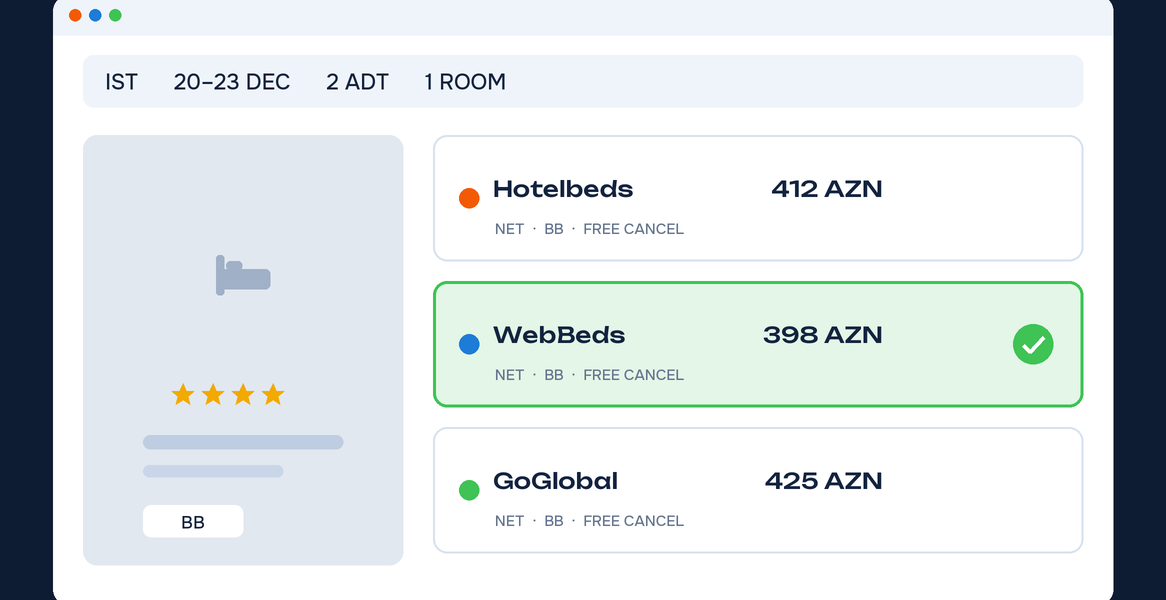
Which bedbank suits you depends on the destinations you sell: the same hotel may be cheaper at one bedbank and missing entirely at another. The full list of suppliers we connect to: integrations.
How a bedbank API works
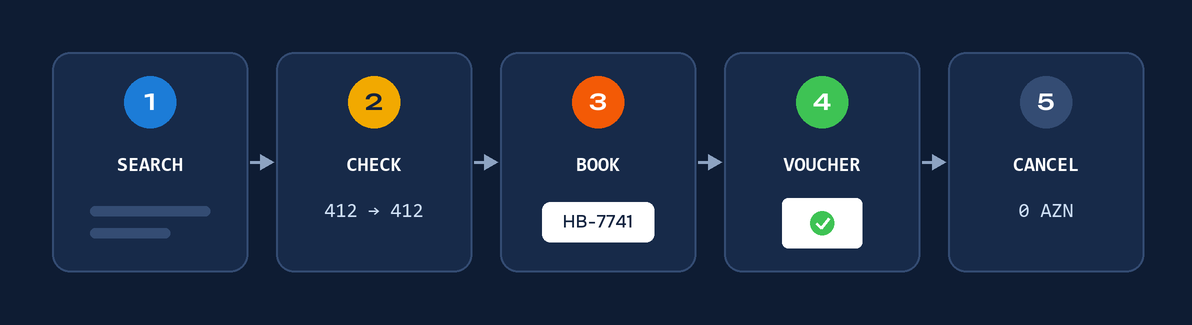
- Search: the system sends a destination or hotel codes, dates, rooms and guests. The bedbank returns available rooms, board type, price and cancellation terms.
- Rate check: when the customer chooses a room, the price and availability are checked again, because they may have changed since the search.
- Booking: a booking is created with the guests’ names, and the bedbank returns a booking reference.
- Voucher: the system sends the hotel voucher to the customer.
- Cancellation and changes: the booking is cancelled from the system according to the cancellation terms, and any penalty is calculated.
Hotel descriptions, images, addresses and facilities (static content) are usually provided through a separate API or files and stored in your own database. The search then asks only for prices and availability in real time. This makes the website much faster.
Concepts you need to know
- Net and commissionable rates: bedbanks usually give net rates, and your markup sets the final price. Some suppliers also send a recommended selling price.
- Board type: RO (room only), BB (breakfast), HB, FB, AI (all inclusive). Codes are written differently from supplier to supplier, so the system must normalise them.
- Cancellation terms: a free cancellation period, then a penalty or a non-refundable rate. The deadline is often counted in the hotel’s local time, so it is important to show it to the customer correctly.
- Taxes paid at the hotel: in some countries a city tax or resort fee is not included in the price and is paid at the hotel. This must be shown to the customer at booking.
- Payment model: a credit limit, a deposit or a prepaid balance. The currency is also agreed in the contract.
Steps to connect to a bedbank
- Contract: a commercial contract is signed with the bedbank: net rates, payment model, credit or deposit. The contract is in your name.
- Test access: the bedbank provides access to its test environment and API documentation. Hotelbeds, for example, gives a free API key on registration, with a daily request limit in the test environment.
- Integration: search, rate check, booking, cancellation and static content are connected to the system.
- Certification: the bedbank reviews the integration. At Hotelbeds, certification also requires a real test booking.
- Go live: after approval, real rates open and sales start.
Several bedbanks together
Many agencies connect to two or three bedbanks, to pick the best price for the same hotel and to offer more hotels. The main challenge here is hotel mapping: the same hotel arrives from different bedbanks under a different name, a different code and sometimes a different address. The system must merge them into one hotel; otherwise the customer sees the same hotel three times in the list. There are dedicated mapping services for this, for example with subscriptions from $499 a month.
On a system that combines several sources: what is a booking engine. To combine hotels and flights into a package: dynamic packaging.
Typical problems and solutions
- The price changes: when the price rises between search and payment, the new price must be shown clearly and the customer’s agreement obtained.
- Room names are messy: names like “Standard Double” and “Double Room Standard” can mean the same room. The system should show room and board information in a readable way.
- Search limits: bedbanks may restrict those who search a lot and book little. Caching and smart searching prevent this.
- The booking not reaching the hotel: in rare cases a booking exists at the bedbank but not at the hotel. Reconfirming with the hotel is common practice for large groups and peak season.
- Image and description rights: using static content on your website is governed by the bedbank’s terms.
What it costs
- Connecting to a bedbank itself: usually free or a nominal fee. The bedbank earns from the net rate.
- Building the integration: development shops estimate one bedbank integration at $5,000–20,000, and some sources at up to $50,000.
- At TT Coders: several bedbank integrations are already built, so they are not developed from scratch. A project costs 500–3,000 AZN, and server and support 50–200 AZN a month. More: pricing.
Checklist for choosing a bedbank
- Number of hotels and prices on the destinations you sell (check with real searches).
- Payment model: credit limit, deposit or balance, and currency.
- Clarity of cancellation terms and the share of non-refundable rates.
- Quality of static content: images, descriptions, coordinates.
- Certification time and quality of technical support.
- Permission to sell to sub-agents. More: B2B travel portal and sub-agent system.
To discuss connecting bedbanks to your website, book a free consultation — we’ll show you our system in demo mode. Our solution: hotel booking system.
Frequently asked questions
What is a bedbank?
A bedbank is a hotel wholesaler that signs contracts with hotels and sells rooms at net rates to tour operators, agencies and online platforms. Hotelbeds, WebBeds, GoGlobal and RateHawk are well-known bedbanks.
Do I need IATA accreditation to connect to a bedbank?
No. You sign a commercial contract with the bedbank; IATA accreditation is not required. Company documents and sometimes a guarantee or deposit are requested, though.
Should I connect to several bedbanks?
One bedbank can be enough at the start. As sales grow, a second and third bedbank bring more hotels and better prices, but then hotel mapping becomes essential.
Is a bedbank rate cheaper than the hotel’s own website?
It is often close: sometimes cheaper, sometimes more expensive. The best result comes from comparing several sources, including direct hotel contracts, in one search.